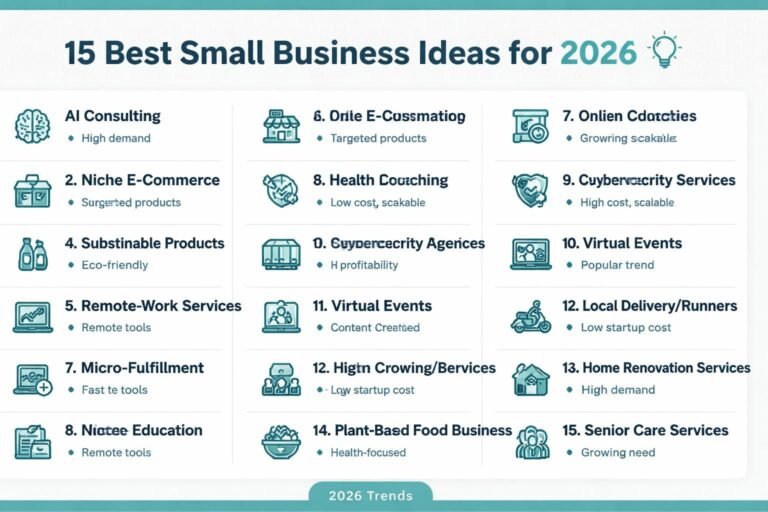

Starting your own business is one of the most powerful ways to take control of your financial future, build something meaningful, and break free from the traditional salary cap. But with thousands of business ideas floating around, choosing the right one can feel overwhelming. This comprehensive guide cuts through the noise and presents the 15 most successful small business ideas you can realistically start today — backed by market demand, real income potential, and low-to-moderate startup costs.
Whether you are looking for a full-time venture, a profitable side hustle, or a home-based business with passive income potential, this guide is built to help self-employed entrepreneurs, first-time founders, and career changers make smarter decisions.
What Makes a Small Business Idea Truly Successful?
Before diving into the list, it is important to understand what separates a good idea from a great one. The most successful small businesses share a few core traits: they solve real problems, serve a clearly defined niche market, generate healthy profit margins, and are scalable without proportionally increasing overhead costs.
A successful business idea must align with three critical factors:
Market demand — Are people actively searching for and spending money on this solution right now?
Your skills and experience — Does the idea leverage your professional strengths and reduce your learning curve?
Financial viability — Can it sustain positive cash flow within 6 to 12 months and become profitable within 2 to 3 years?
With these criteria in mind, here are the 15 most successful small business ideas for 2025 and 2026.
15 Most Successful Small Business Ideas You Can Start Today
1. Freelance Digital Services
Startup Cost: Under $500 | Profit Margin: High | Demand: Rapidly growing
Freelancing remains one of the most accessible and profitable paths for self-employed entrepreneurs. Whether you specialize in freelance writing, graphic design, web development, copywriting, or digital marketing, you can launch with nothing more than a laptop and an internet connection.
Platforms like Upwork and Fiverr have made client acquisition significantly easier, while tools like Canva and Adobe Illustrator lower the barrier to entry for creatives. The rise of remote work culture has permanently shifted how businesses hire talent, and freelance digital services are at the center of that transformation.
Why It Succeeds
Freelancing offers flexible schedule control, minimal startup costs, and the ability to scale into a full-time business once you build a strong personal brand and client portfolio. Many freelancers begin as a side hustle and transition to full-time self-employment once their income replaces their salary.
How to Get Started
Define your core skill set, build a portfolio on a personal website or LinkedIn, and register on two or three freelance platforms. Specialize in a niche — for example, SaaS copywriting or e-commerce SEO — rather than competing broadly.
2. E-Commerce and Dropshipping Business
Startup Cost: Under $1,000 | Profit Margin: High | Demand: Skyrocketing post-pandemic
E-commerce is one of the fastest-growing industries worldwide. Online shopping has become the default for consumers, and entrepreneurs who build well-branded niche online stores — whether through Shopify, Etsy, or Amazon — are capitalizing on that momentum.
Dropshipping is particularly attractive for new entrepreneurs because it eliminates the need to hold inventory. You list products, customers order, and your supplier ships directly. This model dramatically reduces startup capital and operational risk.
Why It Succeeds
E-commerce revenue potential is virtually unlimited and scales without linear cost increases. Combined with organic digital marketing through SEO and social media, a well-positioned online store can generate passive income and strong recurring revenue.
Key Considerations
Product sourcing, supplier reliability, and customer service are the primary operational challenges. Platform fees from Shopify, Etsy, and Amazon must be factored into your profit margins. Competing through a well-defined niche and authentic branding — rather than broad product categories — is essential for sustainable growth.
3. AI Consulting and Technology Services
Startup Cost: $500–$2,000 | Profit Margin: Very High | Demand: Exploding in 2025–2026
AI is no longer a big business advantage. It is becoming table stakes for companies of every size. Small businesses, solopreneurs, and even nonprofits are actively seeking professionals who can help them adopt AI tools to improve efficiency, customer experience, and decision-making.
AI consulting sits at the intersection of digital transformation and business strategy. If you have a background in IT, software development, or business operations, offering AI consulting, managed IT, cybersecurity services, or cloud modernization is one of the highest-income business ideas you can launch today.
Why It Succeeds
Spending on AI, cybersecurity, and cloud services is projected to grow significantly through 2026. Businesses see these as essential investments, not optional upgrades. This demand creates strong opportunities for skilled service providers who can bridge the gap between complex technology and practical business outcomes.
Supporting Services to Bundle
Web and software development, digital marketing consulting, automation setup, and cloud migration services all pair naturally with AI consulting and allow you to increase your average revenue per client.
4. Social Media Management and Content Creation
Startup Cost: Under $1,000 | Profit Margin: Moderate to High | Demand: Very High
Over 77% of Canadians use social media, and the numbers are similarly high across most English-speaking markets. Small businesses, solopreneurs, and growing brands need skilled professionals to manage their social media platforms, create engaging content, and track performance metrics.
Social media management is an ideal business for people with strong writing, design, or marketing skills. Digital creators who understand platform algorithms, audience engagement, and trends can build a profitable client-based business or grow their own social media presence into a monetized brand through affiliate marketing and brand partnerships.
Why It Succeeds
The demand for content creation is consistent and growing. Gen Z and Gen Alpha are gaining buying power and they discover brands on social media rather than through traditional advertising. Businesses that cannot keep up with content demands will continue outsourcing to skilled freelancers and agencies.
How to Stand Out
Specialize by industry (e.g., real estate social media, restaurant content) or by platform (e.g., TikTok growth strategy, LinkedIn B2B content). Results-driven positioning — showing measurable growth in followers, engagement, and conversions — builds credibility and justifies premium pricing.
5. Online Coaching and Course Creation
Startup Cost: $500–$5,000 | Profit Margin: Very High | Demand: Growing Steadily
The online education market is booming. Whether you have expertise in business strategy, health and wellness, creative writing, coding, personal finance, or fitness coaching, turning your knowledge into an online course or coaching program is one of the most scalable business models available.
Platforms like Teachable, Kajabi, and Substack make it possible to reach a global audience from home. Once a course is built, it can generate passive income with minimal ongoing effort.
Why It Succeeds
Online coaching and course creation offer high profit margins because the primary input is your time and knowledge, not physical inventory or equipment. As more individuals seek to upskill online, the market continues to expand across virtually every subject area.
Building Your Authority
Establishing trust and credibility is essential. Publish content on social media, build an email list, and collect testimonials before launching a paid product. A solid marketing funnel — combining content marketing, email sequences, and a clear value proposition — drives consistent course sales.
6. Personal Training and Fitness Coaching
Startup Cost: $1,000–$3,000 | Profit Margin: Moderate to High | Demand: Steady with Niche Growth
The demand for personalized fitness coaching continues to grow as more consumers prioritize health and wellness. Personal training is no longer limited to gym floors — virtual personal training, online fitness programs, and hybrid coaching models have opened this business to a much wider client base.
Wellness spending in the U.S. alone exceeds $500 billion annually, with younger generations driving significant growth. Fitness coaching, health coaching, yoga instruction, and massage therapy are all areas where skilled practitioners can build sustainable, profitable businesses.
Why It Succeeds
Personal training combines recurring revenue from ongoing client relationships with relatively low overhead. Specializing in niche markets — such as prenatal fitness, senior wellness, sports performance, or online training — reduces competition and justifies higher pricing.
Licensing and Certification
Reputable certifications such as CanFitPro or ACE are often required or strongly preferred by clients. Liability insurance is essential to protect your business in the event of client injury.
7. Cleaning Business
Startup Cost: $500–$2,000 | Profit Margin: Moderate to High | Demand: Year-Round
The cleaning industry is worth nearly $2 billion annually in Canada alone and represents one of the most stable, recession-resistant business categories. Whether you focus on residential cleaning, commercial office cleaning, post-construction cleanup, or eco-friendly cleaning services, the demand is consistent and client retention rates are high.
Startup costs are minimal — primarily cleaning supplies and transportation. Word-of-mouth referrals and Google Business Profile optimization drive most of the organic client acquisition for cleaning businesses.
Why It Succeeds
Cleaning is an essential service that homeowners and businesses always need. Once you establish a reliable reputation, clients book on a recurring schedule, providing predictable cash flow and strong customer lifetime value.
How to Differentiate
In a competitive market with low barriers to entry, specialization helps you stand out. Consider positioning around eco-friendly, non-toxic cleaning methods, or focus on high-demand verticals like Airbnb turnover cleaning, post-renovation cleanup, or commercial facilities management.
8. Real Estate Business
Startup Cost: $1,000–$10,000 | Profit Margin: Variable but High | Demand: Consistent
The Canadian real estate market is valued at approximately $257 billion in 2024 and is projected to reach $324 billion by 2033. Globally, real estate remains one of the highest-income business sectors available to small business owners. Whether you pursue real estate as an agent, property manager, or investor, the opportunities are substantial.
Real estate agents work on a commission-based income model, meaning your income directly reflects your effort and your network. Property management services are in consistent demand as rental markets remain tight across major cities.
Why It Succeeds
Real estate is a time-tested business idea that benefits from population growth, housing demand, and both residential and commercial market activity. Successful real estate professionals who combine strong networking skills with smart digital marketing can build highly profitable, scalable businesses.
Important Considerations
Provincial licensing and ongoing education are required for real estate agents. Income can fluctuate with market conditions, making financial planning and budgeting critical, especially in the early years. Marketing expenses for listings, personal branding, and open houses represent a significant but necessary investment.
9. Landscaping and Lawn Care Business
Startup Cost: $2,000–$8,000 | Profit Margin: High in Peak Season | Demand: Consistent in Suburban Areas
Landscaping is a business that never goes out of style. Lawn care, tree trimming, garden design, and seasonal maintenance are always in demand as residential and commercial properties continue to be developed. The landscaping market benefits from stable, repeat-customer relationships and strong word-of-mouth referrals.
Adding snow removal services to your offering balances the seasonal nature of landscaping work and provides year-round revenue stability.
Why It Succeeds
Homeowners are consistently willing to pay for convenience and quality outdoor maintenance. Once you establish a route of reliable clients, scheduling becomes efficient and profit margins improve significantly with scale.
Sustainable Landscaping as a Growth Niche
Sustainable landscaping — featuring water-efficient designs, native planting, and soil health conservation — is emerging as a high-demand niche as more property owners seek eco-friendly alternatives. This positioning commands premium pricing and attracts environmentally conscious clients.
10. Catering Business
Startup Cost: $2,000–$5,000 | Profit Margin: Moderate to High | Demand: Steady and Growing
Canada’s catering industry generates approximately $3.8 billion in annual revenue, with consistent demand driven by corporate events, weddings, and private gatherings. If you have culinary skills and a passion for food, catering is a rewarding and financially viable business to start.
Apps like The Food Corridor now allow caterers to rent licensed commercial kitchens by the hour, dramatically reducing the upfront capital required to launch. Many successful caterers start from home kitchens to minimize initial costs and scale gradually.
Why It Succeeds
Event-driven food services command premium pricing, and specializing in niche menus — such as plant-based, gluten-free, or international cuisines — helps differentiate your business in a competitive market.
Key Operational Considerations
Food safety certifications, health inspections, and proper licensing are non-negotiable requirements. Managing seasonality and building a strong local referral network are essential for maintaining consistent bookings throughout the year.
11. Virtual Assistant Services
Startup Cost: $300–$1,000 | Profit Margin: High | Demand: Rising with Remote Work
As more businesses shift to remote and hybrid work models, the demand for virtual assistants continues to grow. Virtual assistants provide administrative support, email management, calendar scheduling, social media assistance, bookkeeping, and customer service — all from home.
This is one of the most accessible low-cost business ideas for individuals with strong organizational skills and time management abilities. The scalability is also significant: many virtual assistants grow into agencies managing teams of contractors.
Why It Succeeds
Virtual assistant services require minimal startup capital and can begin generating income quickly. Platforms and social media make client acquisition straightforward, and once you establish recurring client relationships, income stability improves considerably.
Building Your Virtual Assistant Business
Start by identifying your strongest administrative skills and positioning yourself in a specific niche — such as executive assistant services for real estate agents, or social media management for health coaches. A professional personal brand and LinkedIn presence accelerate client acquisition significantly.
12. Construction and Trades Business
Startup Cost: $5,000–$10,000 | Profit Margin: High | Demand: Ongoing
Canada’s construction industry is experiencing sustained growth driven by infrastructure development, new housing demands, and an aging housing stock. Notably, 98.9% of construction businesses in the country are small businesses, which highlights just how dominant independent operators are in this space.
If you have trade skills and experience in electrical, plumbing, carpentry, painting, or general contracting, starting your own construction business is one of the most financially rewarding decisions you can make as a skilled tradesperson.
Why It Succeeds
Skilled labour shortages across the construction sector mean qualified, reliable tradespeople can charge premium rates and consistently win work. Repeat clients and referrals from satisfied homeowners and contractors build a stable client base over time.
Licensing, Insurance, and Cash Flow
Provincial certifications are required for many trades. Adequate liability insurance is critical given the physical risks involved. Managing cash flow carefully — as you often front costs for materials and permits before clients pay — is one of the most important business skills to develop early.
13. Handmade Crafts and Print-on-Demand Products
Startup Cost: $200–$1,500 | Profit Margin: Moderate | Demand: Consistent with Growing Online Market
The market for handmade, personalized, and custom products continues to grow as consumers seek authenticity and uniqueness over mass-produced alternatives. Whether you sell handmade jewelry, candles, soaps, pottery, screen-printed apparel, or custom artwork, platforms like Etsy and Shopify make it accessible to reach a global audience from home.
Print-on-demand takes this model further by eliminating inventory entirely. You create designs for merchandise — t-shirts, mugs, phone cases, posters — and a fulfillment partner produces and ships each item only when a customer orders.
Why It Succeeds
Handmade and print-on-demand businesses combine creative fulfillment with the e-commerce model’s scalability. The startup capital required is minimal and the risk is low, making this an ideal side hustle to test before scaling into a full-time venture.
Growing Your Craft Business
Building an audience on Instagram or TikTok around your creative process dramatically accelerates sales. Participating in local markets and craft fairs builds community presence and provides immediate revenue while your online store grows.
14. Bookkeeping and Accounting Services
Startup Cost: $500–$2,000 | Profit Margin: High | Demand: Consistently High
Every business, regardless of size or industry, needs accurate financial record-keeping. Bookkeeping and accounting services represent one of the most stable, recession-resistant small business ideas available. As a self-employed bookkeeper, you can serve multiple small business clients simultaneously, generating strong recurring revenue with predictable monthly income.
Accounting and bookkeeping also serve as a natural foundation for expanding into business consulting, tax preparation, or financial coaching services.
Why It Succeeds
Demand for skilled bookkeepers is constant and broad — every small business owner needs this service but few enjoy doing it themselves. Remote bookkeeping eliminates geographic limitations and allows you to serve clients across multiple cities or countries.
Certifications and Tools
While formal accounting credentials enhance your credibility and command higher rates, many small business bookkeeping clients prioritize reliability and communication over advanced qualifications. Proficiency with tools like QuickBooks, FreshBooks, or Xero is typically expected.
15. Property Management and Short-Term Rental Business
Startup Cost: Variable | Profit Margin: High with Scale | Demand: Growing in Urban and Tourist Markets
Property management is a time-tested business idea that benefits from the ongoing growth of the real estate market and the explosive popularity of short-term rental platforms. Whether you manage long-term residential rentals for landlords or operate a portfolio of Airbnb properties, this business generates consistent passive income and scales effectively with each additional property.
The self-storage sector is also a notable entry point — demand for storage space is driven by urbanization, downsizing trends, and e-commerce returns — and represents a highly passive, cash-flow-positive business model.
Why It Succeeds
Property management services are in consistent demand as more property owners seek professional management rather than handling tenant relations, maintenance coordination, and lease administration themselves. Short-term rental management has become a full-time business for many entrepreneurs, with strong income potential in high-tourism markets.
Key Operational Factors
Understanding local rental regulations, insurance requirements, and tenant rights is essential. Building strong relationships with reliable contractors for maintenance and cleaning ensures consistent service quality and protects your reputation.
How to Choose the Right Small Business Idea for You
Choosing the right business idea comes down to finding the overlap between your skills and experience, your personal and financial goals, and genuine market demand. Here is a proven framework for narrowing down your options.
Assess Your Skills, Experience, and Passion
Start by listing what you already know how to do well. Your existing professional expertise reduces startup time, gives you an immediate competitive advantage, and makes the sustained effort of building a business far more sustainable. Passion matters too — businesses built around work you genuinely care about weather setbacks more effectively.
Define Your Income Target and Time Commitment
Be honest about what you need from your business. Do you need to replace a full-time salary immediately, or are you supplementing existing income? Can you commit 10 to 20 hours per week as a side hustle, or are you ready to go all-in from day one? Different answers lead to very different business models.
Validate Your Idea Before You Invest
Business idea validation means testing whether your concept can succeed before you invest significant time or money. Conduct basic market research, survey potential customers, study your direct competitors, and identify your competitive advantage. A sustainable business typically needs profit margins of 20% or more after all expenses.
Consider Your Startup Capital
Calculate your total costs for the first 12 months — including equipment, marketing, licensing, and operating expenses. If startup costs exceed what you can comfortably invest, start smaller. Many of the most successful businesses on this list began as side hustles with under $1,000 in startup capital.
Funding Your Small Business: From Loans to Grants
Once you have chosen your business idea, securing the right funding is the next critical step. Fortunately, small business owners today have more financing options than ever before.
Small Business Loans
Business loans remain the most commonly used funding tool for small business owners. Both traditional banks and alternative online lenders offer secured and unsecured loans tailored to different business stages and credit profiles. Interest rates, repayment terms, and qualification requirements vary significantly across lenders.
Lines of Credit
A business line of credit offers flexible access to capital without requiring you to reapply each time you need funds. This is particularly valuable for managing cash flow fluctuations, covering seasonal dips in revenue, or handling unexpected operating expenses.
Grants for Small Businesses
Unlike loans, grants do not need to be repaid. Federal and provincial governments offer a range of small business grants focused on innovation, hiring, regional development, and specific industries. Competition for grants can be significant, but securing one can dramatically reduce your startup financial burden.
Bootstrapping and Side Hustle Launch
Many successful entrepreneurs reduce their startup capital requirements by launching first as a side hustle — generating revenue while maintaining a primary income. This approach allows you to test your business concept, build your client base, and validate your market before committing fully.
Trends Shaping Small Business Success in 2026
Understanding the macro trends shaping consumer behavior and market demand is essential for building a business positioned for long-term growth.
AI Adoption and Automation
AI is reshaping every industry. Small businesses that adopt automation tools, AI-powered marketing, and intelligent customer service systems gain significant efficiency advantages over competitors. Service providers who help businesses navigate this digital transformation — through AI consulting, managed IT, or web development — are positioned exceptionally well.
Sustainability and Ethical Business Practices
Sustainability is no longer optional — it is an expectation. Businesses that prioritize transparency, ethical sourcing, and eco-friendly practices are better positioned to attract customers and employees who share those values. Sustainable clothing boutiques, eco-friendly cleaning services, and sustainable landscaping are all examples of this growing consumer preference in action.
Gen Z and Gen Alpha Buying Power
Younger consumers are gaining significant economic influence. They expect authenticity, transparency, and shared values from the brands they support. They discover businesses through social media rather than traditional advertising and are quick to build community around brands they trust. Small businesses that prioritize authentic branding and community building are best positioned to capture this growing market segment.
Home Services and Essential Trades
Homeowners consistently seek trusted, reliable contractors for maintenance, repair, and improvement projects. Once established through strong customer service and referrals, home service businesses — including cleaning, landscaping, plumbing, electrical, and handyman services — generate stable recurring revenue with strong customer lifetime value.
Frequently Asked Questions About Starting a Successful Small Business
What is the most profitable small business to start with little money?
Service-based businesses — including freelance writing, virtual assistant services, social media management, bookkeeping, and online coaching — consistently deliver strong profit margins with minimal startup capital. Most require only a computer and internet connection to launch.
How long does it take for a small business to become profitable?
Most small businesses take 6 to 12 months to generate consistent revenue and 2 to 3 years to become fully profitable. Timeline varies based on industry, startup investment, and the time you can dedicate weekly. Starting as a side hustle and scaling incrementally can compress this timeline for service-based businesses.
Should I start a side hustle or go full-time right away?
Start as a side hustle if you have limited savings or are still validating your market. This approach allows you to test your business concept, build initial revenue, and maintain financial stability during the startup phase. Transition to full-time once your business income can sustainably replace your primary salary.
What skills do I need to run a small business successfully?
Core skills include basic accounting and financial management, marketing and client acquisition, customer service, and time management. You do not need to excel at everything immediately. Focus on your strengths and outsource or learn the remaining skills as your business grows and revenue allows.
Is it possible to start a small business with no money?
Yes. Many of the most successful business ideas — including freelancing, virtual assistance, dropshipping, online tutoring, and consulting — can be started with little to no upfront investment. Focus on business models that leverage your existing skills, start small, and reinvest early revenue into growth.
Final Thoughts: Your Path to Small Business Success
The most successful small business ideas in 2025 and 2026 share a common foundation — they solve real problems, serve a clearly defined niche, generate strong profit margins, and are built on genuine skills and passion.
Whether you are drawn to the flexibility of freelancing, the scalability of e-commerce, the stability of essential services like cleaning and bookkeeping, or the income potential of AI consulting and real estate, there has never been a better time to take control of your career direction and build something of your own.
Start by validating your idea, building a simple business plan, and exploring the funding options that align with your goals. The entrepreneurial ecosystem is rich with resources, tools, and communities designed to support your journey at every stage.
The question is not whether the right opportunity exists for you — it does. The question is which one aligns best with who you are and where you want to go.